Cyprus History Explained: From the Stone Age to Division and Today
The history of Cyprus goes back around 12,000 years. Because of its position in the eastern Mediterranean and its copper, the island was ruled in turn by Greeks, Phoenicians, Persians, Romans, Byzantines, Crusaders, Venetians, Ottomans and the British. Cyprus became independent in 1960 and has been divided since 1974. The Republic of Cyprus has been a member of the European Union since 2004. Around Paphos you can visit almost every period yourself – from the Tombs of the Kings to the harbour castle.
- Cyprus history at a glance
- Stone Age and Copper Age: the first settlers
- Bronze Age and antiquity: copper, Aphrodite and Rome
- Byzantium, Crusaders and Venice
- Ottoman rule (1571–1878)
- British rule and independence
- 1963 to 1974: violence, coup and division
- Cyprus today: EU, euro and reunification
- Where to see history around Paphos
- FAQs
- Conclusion
On holiday in Cyprus you keep bumping into history: Roman mosaics in Paphos, a medieval castle on the harbour, driving on the left and British plugs – and a capital city with a border running through it. We live in Coral Bay near Paphos, where we rent out two holiday villas, and our guests often ask us why the island is divided or why people drive on the left here. In this guide we explain the history of Cyprus in a short, clear way, from the first settlers in the Stone Age to the reunification talks of 2026. At the end we show you where you can see each period for yourself around Paphos and Coral Bay.
History of Cyprus at a glance: the main periods
The island of Cyprus sits at the crossroads of Europe, Asia and Africa. Its position in the eastern Mediterranean and its rich copper deposits made it a prize for great powers for thousands of years – which is why Cyprus has such a turbulent history. The table shows the periods at a glance, with places near Paphos where you can still find them today:
| Period | Dates | Traces near Paphos |
|---|---|---|
| Stone Age & Copper Age | c. 10,000–2500 BC | Lemba settlement |
| Bronze Age & city kingdoms | c. 2500–325 BC | Sanctuary of Aphrodite at Kouklia |
| Hellenistic & Roman | 325 BC–AD 395 | Tombs of the Kings, Archaeological Park |
| Byzantine | 395–1191 | Agia Kyriaki, Saranta Kolones |
| Lusignan & Venetian | 1192–1571 | Harbour castle (origins 13th century) |
| Ottoman Empire | 1571–1878 | Harbour castle (rebuilt 1592), Old Town |
| British rule | 1878–1960 | Driving on the left, colonial buildings in Ktima |
| Republic of Cyprus | since 1960, divided since 1974 | Green Line in Nicosia |
Stone Age and Copper Age: the first settlers in Cyprus
How old is Cyprus history? The earliest traces of people on the island come from the rock shelter of Akrotiri-Aetokremnos on the south coast. According to archaeologists, hunter-gatherers were there by around 10,000 BC – at the same time as the island’s now extinct pygmy hippos. Who were the first people in Cyprus, then? Seafarers: Cyprus was never connected to the mainland, so the first settlers must have arrived by boat.
The best-known Neolithic site is Choirokoitia between Larnaca and Limassol. The village of round stone houses was lived in from around 7000 BC and has been a UNESCO World Heritage Site since 1998. In the Copper Age (about 3900–2500 BC) most settlements were in the west of the island. An important site is Lemba, a village between Paphos and Coral Bay. A fertility cult developed in western Cyprus at this time, and people began to work copper.
Where does the name Cyprus come from? A popular explanation links it to copper: the Latin word for copper, “cuprum”, and the chemical symbol Cu go back to the island. Whether the name Cyprus itself comes from the metal or the other way round has never been settled.
Bronze Age and antiquity: copper, Aphrodite and the Roman Empire
Why was copper so important for Cyprus? From the start of the Bronze Age around 2500 BC, copper was needed to make bronze – and the island had plenty of it, especially in the Troodos Mountains. Cyprus traded with Egypt, the Near East and the Aegean and grew wealthy. Towards the end of the Bronze Age, in the 12th century BC, Greek settlers from the Mycenaean world arrived. They brought the Greek language, which is still spoken by the majority of Cypriots today.
This is also when the Sanctuary of Aphrodite was founded at Palaepaphos, today the village of Kouklia near Paphos. It was one of the most important centres of the goddess in the ancient world – according to legend, Aphrodite was born from the sea just a few kilometres away at Aphrodite’s Rock. Afterwards the island was ruled by several city kingdoms, including Paphos, Salamis and Kition, where Phoenicians settled. Over the following centuries Cyprus came under Assyrian and Egyptian control, and from the 6th century BC under Persian rule.
With Alexander the Great, Cyprus joined the Hellenistic world from 333 BC, and in 294 BC it passed to the Ptolemies of Egypt. Paphos gained a new city: Nea Paphos, founded at the end of the 4th century BC by Nicocles, king of Palaepaphos. Under the Ptolemies, Nea Paphos became the capital of the island. The Tombs of the Kings, a necropolis carved into the rock, date from this time. In 58 BC Cyprus became a Roman province, with Paphos still its capital. You can see the grand villas with their floor mosaics in the Paphos Archaeological Park.
Did Jesus ever go to Cyprus? There is no record of that, but his apostles did. According to the Acts of the Apostles, Paul and Barnabas came to Paphos in AD 45 and converted the Roman proconsul Sergius Paulus, making Cyprus one of the first places with a Christian ruler. Next to the church of Agia Kyriaki in Kato Paphos stands St Paul’s Pillar, where tradition says Paul was flogged – although there is no historical evidence for this.
Byzantium, Crusaders and Venice: Cyprus in the Middle Ages
After the Roman Empire split, Cyprus belonged to the Byzantine Empire from 395, with its capital in Constantinople. The Orthodox Church shaped the island’s culture and religion, and many churches and monasteries were built – ten churches with wall paintings in the Troodos Mountains are now on the UNESCO World Heritage List. From the 7th century the coast suffered repeated Arab raids.
In 1191 King Richard the Lionheart of England conquered the island during the Third Crusade. He sold it to the Knights Templar, who gave it up again in 1192 after a local uprising. The new ruler was Guy de Lusignan, from a French noble family. The Lusignans ruled Cyprus as a kingdom for almost 300 years, introduced a feudal system and made the Catholic Church the official church – much to the displeasure of the Orthodox population. In Paphos they replaced the Saranta Kolones fortress, destroyed in the earthquake of 1222, with a new castle at the harbour.
In 1489 the last queen, Caterina Cornaro, handed the island over to the Republic of Venice. The Venetians saw Cyprus mainly as a bulwark against the Ottoman Empire and built the massive city walls of Nicosia and Famagusta, which you can still see today.
Ottoman rule in Cyprus (1571–1878)
In 1570 an Ottoman army landed and captured Nicosia; in 1571 Famagusta fell after a long siege. Cyprus became part of the Ottoman Empire for a little over three hundred years. The Ottomans recognised the Orthodox Church again, and the archbishop became the leader of the Greek Cypriot community. At the same time thousands of Muslims were settled on the island – much of today’s Turkish Cypriot community traces its roots to them. For centuries Greek and Turkish Cypriots lived side by side in many villages.
Paphos harbour castle tells this story too: the Venetians dismantled it themselves during the attack of 1570, and the Ottomans rebuilt it – an inscription above the entrance gives the year 1592. For opening hours and tickets, see our guide to Paphos Harbour and Castle.
British rule and the road to independence (1878–1960)
Under the Cyprus Convention of 1878, Britain took over the administration of the island from the Ottomans, although it formally remained part of the Ottoman Empire. When the Ottoman Empire entered the First World War on the other side, the annexation of the island followed in November 1914, and in 1925 the island officially became a British Crown colony. Some things visitors notice to this day date from British rule: Cypriots drive on the left – see our guide to car rental in Cyprus – and the plugs are British, as we explain in Cyprus plug type and travel tips. Many people also speak good English.
Among Greek Cypriots the call grew for enosis – handing the island to Greece. In 1931 the British put down a first uprising. On 1 April 1955 the National Organisation of Cypriot Fighters, EOKA, began a guerrilla war against British rule. Most Turkish Cypriots opposed enosis. Why did the UK give up Cyprus? After years of violence, Britain, Greece and Turkey agreed on a framework for an independent state in 1959. On 16 August 1960 Cyprus gained its independence and the independent Republic of Cyprus was born, with Archbishop Makarios III as its first president. The constitution shared power between the Greek Cypriot majority and the Turkish Cypriot community, and Britain, Greece and Turkey became guarantor powers under a treaty. Britain kept two military bases, Akrotiri and Dhekelia, which are still British sovereign territory today.
1963 to 1974: violence, coup and the division of Cyprus
Why is Cyprus divided, and since when? Independence did not bring the hoped-for peace. In late 1963 and 1964 heavy fighting broke out between the Greek and Turkish communities, and several hundred people were killed. Many Turkish Cypriots withdrew into enclaves. In March 1964 the United Nations sent a peacekeeping force, UNFICYP, to the island; it keeps a presence on the island to this day.
In 1967 a military junta seized power in Greece. The decisive year was 1974: in the summer of 1974 came the coup in Cyprus. On 15 July Greek Cypriot National Guard officers, backed by the junta in Athens, staged a coup against President Makarios. On 20 July 1974 Turkish troops landed in the north of the island; three days later the junta in Athens collapsed. In mid-August Turkish forces advanced further, and since then Turkish troops have controlled the northern part of the island – more than a third of its area. Around 162,000 Greek Cypriots fled or were expelled from the north, and around 48,000 Turkish Cypriots moved from the south to the north – displacement that still shapes many families on both sides. The Republic of Cyprus, the EU and most states describe the events as the Turkish invasion of Cyprus and an ongoing occupation; Turkey calls it a peace operation to protect the Turkish Cypriot minority and points to its role as a guarantor power.
Since then a UN-patrolled buffer zone, the Green Line, has marked the division of the island, running right through the capital, Nicosia. In 1983 the Turkish Cypriot leadership declared the Turkish Republic of Northern Cyprus. Only Turkey recognises it; the UN Security Council declared the declaration legally invalid. Internationally, the Republic of Cyprus is recognised as the state for the whole island.
Cyprus today: EU, euro and the question of reunification
On 23 April 2003 the first crossing point in the buffer zone opened at the Ledra Palace in Nicosia – for the first time in decades, Turkish and Greek Cypriots could visit the other side. Today there are several crossings between north and south, including Ledra Street in Nicosia’s old town since 2008. In April 2004 both communities voted on the Annan Plan, the UN’s reunification plan for Cyprus: around two thirds of Turkish Cypriots voted yes, while around three quarters of Greek Cypriots voted no, so the plan failed. On 1 May 2004 the Republic of Cyprus joined the European Union anyway, but EU law applies only in the areas under the government’s control. Cyprus adopted the euro in 2008 – more on money and prices in Cyprus currency and prices.
There have been many attempts at reuniting Cyprus and solving the Cyprus problem; the last major round of talks in Switzerland collapsed in July 2017. New momentum came with the election of Tufan Erhürman as Turkish Cypriot leader, who favours a federal settlement. UN Secretary-General António Guterres visited the island at the end of July 2026 and met President Nikos Christodoulides and Erhürman; in August 2026 the two leaders agreed to meet weekly. Christodoulides wants to resume talks where they ended in 2017, on the basis of a bizonal, bicommunal federation, while Erhürman wants agreement on political equality first. At the end of October 2026 UN envoy María Ángela Holguín said she was hopeful that an informal meeting in a wider format could take place before the end of the year (as of November 2026).
For holidaymakers in the south, the division plays almost no role in everyday life: the Republic of Cyprus is generally considered a safe destination – see Is Cyprus safe?. The north is run by a Turkish Cypriot administration; if you want to visit, you can walk across at the crossing points with your passport or ID card, most easily in Nicosia. Tips for a day trip to the divided capital are in our guide to things to do in Nicosia.
Where to see Cyprus history around Paphos and Coral Bay
Is Cyprus good for history? Paphos is the perfect place to find out: the whole town has been a UNESCO World Heritage Site since 1980, including the ancient city in Kato Paphos, the Tombs of the Kings and the Sanctuary of Aphrodite at Kouklia. In 2017 Paphos was a European Capital of Culture. From our villas in Coral Bay the main sites are close by:
| Site | Period | From Coral Bay |
|---|---|---|
| Tombs of the Kings | Hellenistic, Roman | 11 km, approx. 15 min |
| Paphos Archaeological Park | Hellenistic to medieval | 13 km, approx. 20 min |
| Agia Kyriaki & St Paul’s Pillar | Early Christian, Byzantine | 14 km, approx. 25 min |
| Paphos Castle | Lusignan, Ottoman | 13 km, approx. 22 min |
| Paphos Old Town (Ktima) | Ottoman, British | 11 km, approx. 18 min |
| Sanctuary of Aphrodite (Kouklia) | Bronze Age, antiquity | 31 km, approx. 40 min |
| Aphrodite’s Rock | Mythology | 35 km, approx. 40 min |
| Kykkos Monastery | Byzantine | 77 km, approx. 1 hr 45 min |
| Nicosia (Green Line) | Venetian to present | 161 km, approx. 2 hr 20 min |
In Paphos Old Town you will find traces of the Ottoman and British periods, while the Troodos Mountains have Byzantine churches and Kykkos Monastery. More historic day trips – such as the Church of St Lazarus in Larnaca – are covered in things to do in Larnaca and Paphos to Limassol. For all the sights in the area, see our guide to things to do around Coral Bay, and to combine several places in one trip, try our Cyprus itinerary from Paphos. If you prefer a guided tour, these two are a good fit:
From Paphos: Cyprus Through the Ages tour with lunch and wine
About 8 hours to Aphrodite’s Rock, ancient Kourion, the Crusader castle of Kolossi and the wine village of Omodos, with lunch and a wine tasting. Rated 4.5 out of 5 from 26 reviews on GetYourGuide (as of 12 November 2026).
If you book through this link, we earn a small commission – the price stays the same for you.
From Paphos: Nicosia and Lefkara guided tour
About 8 hours with pickup in Paphos (including Coral Bay), a walk through Nicosia’s old town and a crossing at Ledra Street into the northern part of the city – bring your passport or ID card. Rated 4.2 out of 5 from 229 reviews on GetYourGuide (as of 12 November 2026).
If you book through this link, we earn a small commission – the price stays the same for you.
FAQs about the history of Cyprus
Where does the name Cyprus come from?
The name is often linked to copper, which has been mined on the island since the Copper Age. The Latin word “cuprum” and the chemical symbol Cu go back to Cyprus. Whether the island’s name comes from the metal or the other way round is not certain.
Why is Cyprus divided?
After fighting between Greek and Turkish Cypriots in the 1960s, Greek Cypriot officers backed by the junta in Athens staged a coup against President Makarios on 15 July 1974. On 20 July 1974 Turkish troops landed in the north. Since then a UN buffer zone has separated north and south. The Turkish Republic of Northern Cyprus, declared in 1983, is recognised only by Turkey.
Was Cyprus ever Greek?
Greek settlers arrived as early as the 12th century BC, and Greek is still the majority language. But Cyprus was never part of the modern Greek state: after Ottoman and British rule it became an independent country in 1960. Enosis, unification with Greece, never happened.
Who owned Cyprus first?
The first known inhabitants were hunter-gatherers around 10,000 BC. In the Bronze Age the island was ruled by local city kingdoms, followed by Assyrians, Egyptians, Persians, the Ptolemies and Rome. Later came Byzantium, Richard the Lionheart, the Lusignans, Venice, the Ottomans and Britain until independence in 1960.
What language is spoken in Cyprus?
The official languages are Greek and Turkish. Greek is spoken in the south and Turkish in the north. Thanks to British rule, English is also widely spoken, especially in tourist areas such as Paphos.
Conclusion: Cyprus history – 12,000 years on one island
Few islands in the Mediterranean have had as many rulers as Cyprus: after the first settlers came Greeks, Phoenicians, Persians, Romans, Byzantines, Crusaders, Venetians, Ottomans and the British. Every period has left its mark on the people of Cyprus, from the mosaics of Paphos to driving on the left. Since independence in 1960 and division in 1974, the Cyprus conflict has shaped the island; there is still no solution, but talks are moving again. For your holiday, that mostly means one thing: around Paphos, history is right on your doorstep. For more ideas, see our guide to planning Cyprus holidays and our hidden gems near Coral Bay.
Sources: ancient periods and dates from the Cyprus Institute of Neurology and Genetics (Cyprus History), World History Encyclopedia, the Ashmolean Museum (Ancient Cyprus) and Encyclopedia.com (Akrotiri-Aetokremnos); Nea Paphos from the Polish Centre of Mediterranean Archaeology (University of Warsaw); World Heritage Sites from the UNESCO World Heritage Centre; Paul and Sergius Paulus from Acts 13 and St Paul’s Catholic Parish, Paphos; Middle Ages and Ottoman conquest from Britannica and the Cyprus Institute of Neurology and Genetics; harbour castle and 1592 inscription from Visit Cyprus; British rule and EOKA from Imperial War Museums and Britannica; 1959 to 1983, displacement figures and the share of the north from the German Federal Agency for Civic Education (bpb, August 2025); crossing points from Cyprus Mail and the UN; Annan Plan from bpb and the Government of Cyprus (Cyprus at a Glance); talks 2017 to 2026 from AFP/Ahram Online (26 August 2026), Turkish Minute (27 July 2026) and Euronews (30 October 2026); distances from Coral Bay from our guides and by route planner (OSRM); tours from GetYourGuide (12 November 2026). Featured image: Theseus mosaic in the House of Theseus, Paphos Archaeological Park, photo by Wolfgang Sauber, CC BY-SA 3.0, Wikimedia Commons (cropped). As of November 2026.
Your place to stay in Coral Bay
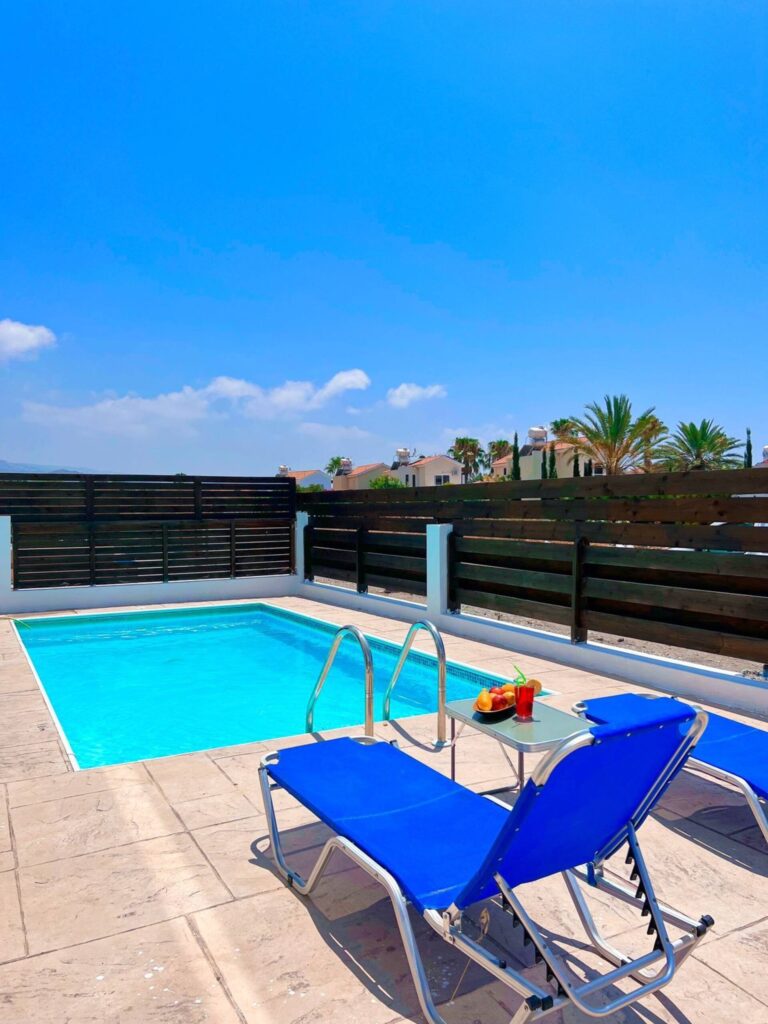
Two private pool villas with sea views – about 15 minutes from the Tombs of the Kings and Paphos Archaeological Park. History in the morning, the pool in the afternoon and sunset in the evening. Book direct with your host.
Check availability