Kourion, Cyprus: Archaeological Site, Theatre and Tips for Your Visit
Kourion (Latin Curium) is one of the most impressive archaeological sites in Cyprus: an ancient city-kingdom on a clifftop overlooking the sea above Episkopi Bay, about 19 km west of Limassol on the southern coast of Cyprus. Highlights are a Greco-Roman theatre with Mediterranean views, the mosaics in the House of Eustolios and the early Christian basilica. Entry costs €4.50 and the site opens daily from 8:30am. From Coral Bay it is about 65 km, just over an hour’s drive.
Cyprus is home to many ancient remains, but an ancient theatre on a clifftop with nothing behind it but the sea is something special: few places on the island look as much like a postcard as Kourion. We live in Coral Bay near Paphos, where we rent out two holiday villas, and many of our guests ask whether the trip to the south coast is worth it. Our answer: yes, especially if you love ancient history or simply want one of the best views on the island. In this guide you will find out what to see at Kourion, how much the entrance fee is, the best time to go and how to combine your visit with the beach, Kolossi Castle or Limassol.
Kourion archaeological site at a glance
| Info | Kourion |
|---|---|
| Location | near Episkopi, about 19 km west of Limassol |
| From Coral Bay | about 65 km, just over 1 hour by car |
| Opening hours | 16 Apr–15 Sep daily 8:30am–7:30pm, 16 Sep–15 Apr daily 8:30am–5pm |
| Entrance fee | €4.50 (Sanctuary of Apollo Hylates separate, €2.50) |
| Time needed | 1.5–2 hours |
| Closed | 25 Dec, 1 Jan and Orthodox Easter Sunday |
| Accessibility | part of the site is accessible |
History of Kourion: from city-kingdom to Roman city
People lived around the mouth of the Kouris River as early as the Neolithic period. The city of Kourion itself goes back to the late second millennium BC, when Greek settlers from the Mycenaean world arrived on the south coast. According to the ancient geographer Strabo, Kourion was founded by settlers from Argos in the Peloponnese. The city first appears in writing in the 7th century BC: around 672 BC the Assyrian king Esarhaddon lists a King Damasu of “Ku-ri-i” among his vassals. Kourion was one of the Cypriot city-kingdoms of ancient Cyprus, alongside Paphos, Salamis and Kition.
After the Persians and Alexander the Great, Kourion entered the Hellenistic world and came under Ptolemaic rule in 294 BC, and in 58 BC it became part of the Roman Empire. The city flourished in the Roman period, and most of the ruins of Kourion you see today date from the Roman and early Byzantine eras – the theatre, agora, Roman baths and villas with mosaic floors. Life in Kourion changed with a series of earthquakes in the 4th century AD, the strongest on 21 July 365. The city was rebuilt as a Christian town, and a large cathedral went up in the 5th century. After Arab raids in the 7th century, people moved to the nearby village of Episkopi, whose name means “bishopric”.
Excavation began in 1933 under the University of Pennsylvania; other university missions and the Cyprus Department of Antiquities continued the work. To see how Kourion fits into the island’s story, read our guide to Cyprus history.
What to see at Kourion: the main highlights
What are the main highlights of the Kourion archaeological site? The ancient city of Kourion sits on a limestone hill almost 100 metres high, right on the coast – the ruins of the ancient city spread across the hill of Kourion. These are the sights you should not miss:
The theatre of Kourion
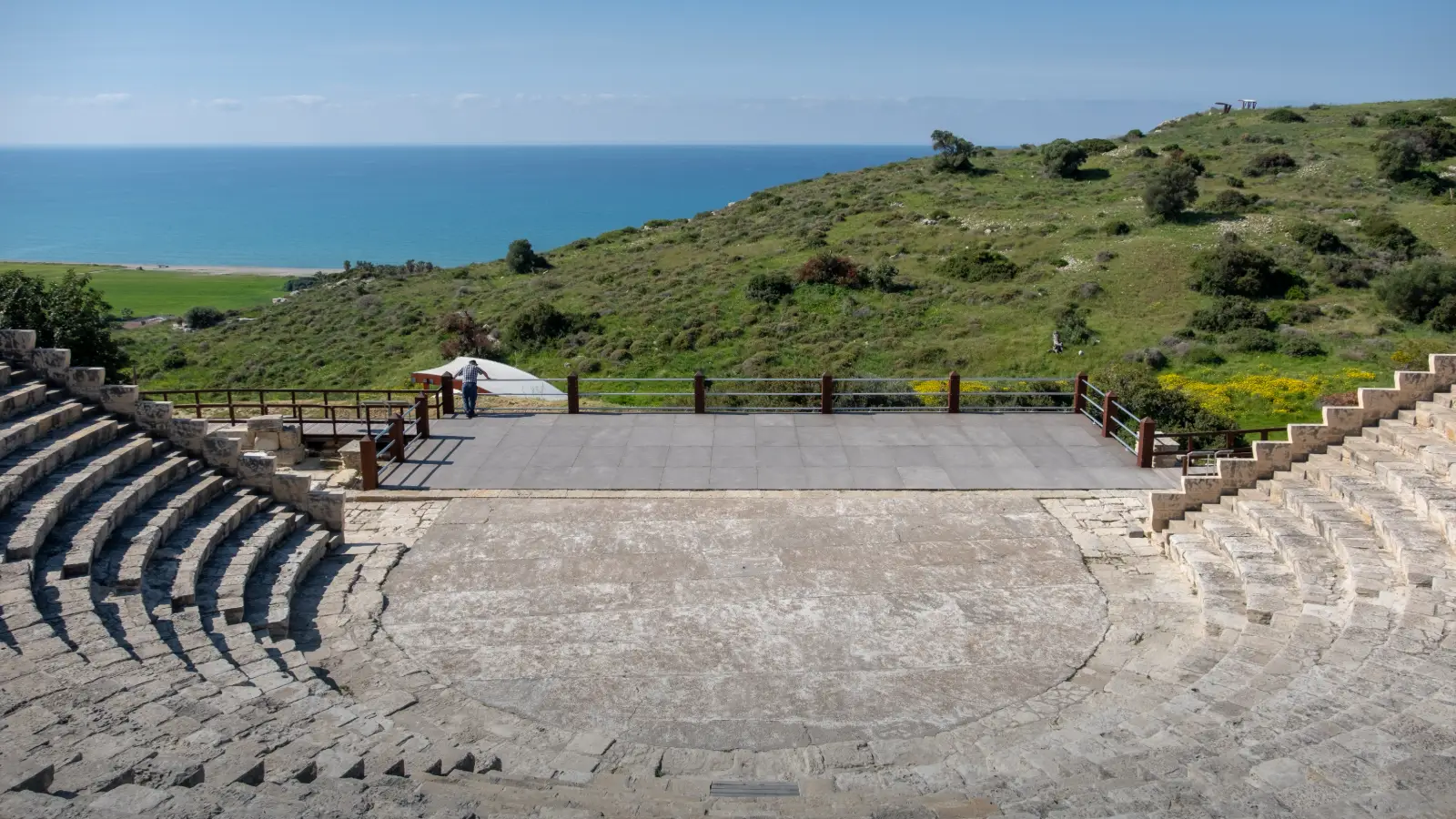
The Greco-Roman theatre is the icon of the site. It was constructed at the end of the 2nd century BC and reached its present size in the 2nd century AD, seating up to 3,500 spectators. At the beginning of the 3rd century AD it was turned into an arena for fights with wild animals, before returning to use as a theatre by the end of the century. It is often called the Kourion amphitheatre (amphitheater in US spelling), but strictly speaking it is an ancient theatre with a semicircular auditorium. Its shape changed during the 2nd and 3rd centuries AD. From the top rows you get the best view of the Mediterranean Sea, and today it is used for cultural events every summer.
House of Eustolios
Just east of the theatre lies the House of Eustolios. It probably dates to the early 5th century AD and is named after its builder, mentioned in an inscription. A mosaic with a welcoming inscription greets you at the entrance, and three porticoes have beautiful mosaics – including Christian symbols such as fish and cross motifs. A bath complex lies to the north. Interestingly, the inscriptions mention the owner’s Christian faith alongside Apollo, the city’s old patron god.
Early Christian basilica
At the top of the hill stand the remains of the early Christian basilica of Kourion, the city’s cathedral from the 5th century AD – a building with three aisles and a single apse. It shows how quickly Kourion became a Christian city after the earthquakes. The church was destroyed during Arab raids in the 7th century.
Agora, nymphaeum and Earthquake House
In the centre of the ancient city lies the Roman agora, the marketplace with its colonnades, next to public baths and a large nymphaeum – a monumental fountain fed by an aqueduct. Nearby, archaeologists found the so-called Earthquake House: under the rubble lay the skeletons of a couple with a child and of a tethered mule, victims of the earthquakes around 365. The finds were shown in the Local Archaeological Museum in Episkopi, which has been closed for upgrade works since 1 August 2026.
House of the Gladiators and House of Achilles
On the northwestern edge of the hill, close to the road, are two more villas with ancient mosaics. The House of the Gladiators dates from the second half of the 3rd century AD; its mosaics show gladiators in combat, a rare subject in Cyprus. The House of Achilles from the 4th century AD is named after a mosaic showing Odysseus unmasking the young Achilles, and it was most likely used as a reception for official guests. Both houses lie a little away from the theatre – allow a few extra minutes to walk there.
The stadium and the Sanctuary of Apollo Hylates
Two more sites west of the main area belong to ancient Kourion, along the old road to Paphos. The Roman stadium from the 2nd century AD held about 6,000 spectators and was in use until the end of the 4th century; some rows of seats have been reconstructed.
About 3 km west of the ruins lies the Sanctuary of Apollo Hylates – Apollo “of the woodlands” and protector of Kourion. People worshipped here from the 8th century BC to the 4th century AD. Most of what you see today comes from restorations in the 1st century AD: a partly rebuilt temple of Apollo, pilgrims’ halls, a palaestra (exercise ground), baths and the sacred precinct. The sanctuary is quieter than the main site and has its own entrance: €2.50, same opening hours. Allow about 45 minutes extra.
Opening hours, entrance fee and tips for your visit to Kourion
The Kourion archaeological site is open all year: from 16 April to 15 September daily from 8:30am to 7:30pm, and from 16 September to 15 April daily from 8:30am to 5pm. It is closed only on 25 December, 1 January and Orthodox Easter Sunday. What is the entrance fee for Kourion? It costs €4.50, and groups of more than 10 people get 20% off. If you plan to visit several state-run sites, the Department of Antiquities sells multi-site cards: €8.50 for one day, €17 for three days and €25 for seven days. They pay off if you add Kolossi Castle and the Apollo sanctuary on the same day, or the Tombs of the Kings and the Paphos Archaeological Park. Hours and prices can change at short notice.
- Parking: the car park is right at the entrance and free.
- Best time of day: right at opening time at 8:30am or in the last two hours before closing – cooler, and the light over the sea is at its best.
- Shoes: wear sturdy shoes rather than flip-flops; the paths are stony and uneven.
- With children: kids usually enjoy the theatre and the mosaics, but a pushchair is hard work on the uneven paths. For more ideas see our Cyprus family holiday guide.
- British territory: Kourion lies within the British Sovereign Base Area of Akrotiri but is managed by the Cyprus Department of Antiquities. For visitors nothing changes – there are no checks.
Is Kourion worth visiting? If you only see one ancient site outside Paphos, make it Kourion: the clifftop setting overlooking the sea is unique, it ranks among the most important ancient Greek and Roman sites on the island and is one of the top attractions on the south coast. Back in Paphos, the whole town is a UNESCO World Heritage Site in its own right. In high season it gets busy around midday, when many coach tours arrive. To find out when Cyprus is pleasantly warm, see our guide to the best time to visit Cyprus.
Getting to Kourion from Coral Bay and Paphos
Where is Kourion in Cyprus? The site lies on the south coast between Paphos and Limassol, above the village of Episkopi. The easiest way to get there is by car: from Coral Bay you drive past Paphos towards Limassol, and the route is well signposted. For tips on driving on the left, see our guide to car rental in Cyprus. If you would rather not drive, book a guided tour with pickup – we suggest two further down.
| Route | Distance | Driving time |
|---|---|---|
| Coral Bay → Kourion | 65 km | approx. 1 hr 5 min |
| Kato Paphos → Kourion | 57 km | approx. 50 min |
| Aphrodite’s Rock → Kourion | 31 km | approx. 30 min |
| Kourion → Apollo sanctuary | 4 km | approx. 5 min |
| Kourion → Kolossi Castle | 6 km | approx. 7 min |
| Coral Bay → Kolossi Castle | 69 km | approx. 1 hr 10 min |
Combine Kourion with the beach, Kolossi Castle and Limassol
Because the drive from Coral Bay takes just over an hour, it makes sense to visit Kourion as part of a day trip:
- Aphrodite’s Rock: Aphrodite’s Rock (Petra tou Romiou) is right on the way – perfect for a photo stop on the way there or back.
- Kourion Beach: below the site is a long beach with parking, showers, sunbeds and fish tavernas. Ideal for a swim and lunch after the ruins.
- Kolossi Castle: the Crusader castle, originally built in the 13th century and rebuilt in its present form in the 15th, is just a few minutes away. Entry €2.50, same opening hours as Kourion.
- Limassol: the old town, castle and marina are about 20 to 25 minutes away. See our guide Paphos to Limassol for what to do there.
- Wine villages: if you have time, head up into the hills to Omodos – more in our guide to Omodos and the wine villages.
For more day trip ideas, see our guides to excursions from Paphos and our Cyprus itinerary from Paphos. Are guided tours available at Kourion? Yes – these two include pickup in the Paphos area:
From Paphos: trip to Limassol with Kourion and Kolossi Castle
About 7 hours with a photo stop at Aphrodite’s Rock, over an hour at Kourion, Kolossi Castle and free time in Limassol. Entry to Kourion and Kolossi included, pickup from many hotels in the Paphos area including Coral Bay; guided in English. Rated 4.6 out of 5 from 209 reviews on GetYourGuide (as of 14 November 2026).
If you book through this link, we earn a small commission – the price stays the same for you.
From Paphos: Cyprus Through the Ages tour with lunch and wine
About 8 hours with Kourion, Kolossi Castle, lunch at a taverna, a walk through Omodos and a wine tasting; entry fees included. Rated 4.5 out of 5 from 26 reviews on GetYourGuide (as of 14 November 2026).
If you book through this link, we earn a small commission – the price stays the same for you.
Concerts and plays at the ancient theatre of Kourion
The ancient theatre is more than a ruin: from June to September it hosts concerts and plays, including performances at the International Festival of Ancient Greek Drama. In summer 2026, for example, the programme included a choral festival (19–21 June), Shakespeare’s “Othello” in English (9–11 July), an evening of songs by Mikis Theodorakis (25 July) and a concert by the tenor Massimo Giordano (19 September). A performance at sunset with a view of the Mediterranean is a special experience – bring a cushion and a jacket, as the stone seats get cool in the evening. For more summer ideas, see Cyprus in summer.
FAQs about Kourion
Is Kourion worth visiting?
Yes. Kourion is one of the most impressive archaeological sites in Cyprus, with a Greco-Roman theatre on a clifftop overlooking the sea, well-preserved mosaics and an early Christian basilica. Allow 1.5 to 2 hours and combine it with Kourion Beach or Kolossi Castle for a full day trip.
What is the entrance fee for Kourion?
Entry to the Kourion archaeological site costs €4.50 per person. The Sanctuary of Apollo Hylates has a separate ticket for €2.50. If you visit several state-run sites, the Department of Antiquities sells multi-site cards for €8.50 (one day), €17 (three days) and €25 (seven days).
How old is the Kourion amphitheatre?
The theatre was built at the end of the 2nd century BC and enlarged to its present size in the 2nd century AD, when it held up to 3,500 spectators. In the early 3rd century AD it was briefly used as an arena for animal fights. Today it hosts concerts and plays in summer.
How far is Kourion from Paphos?
From Kato Paphos it is about 57 km, roughly 50 minutes by car towards Limassol; from Coral Bay about 65 km. There is a free car park at the entrance. Alternatively, guided tours with pickup in the Paphos area often combine Kourion with Kolossi Castle and Limassol.
Is Kourion a UNESCO World Heritage Site?
No, even though you sometimes read that it is. Cyprus has three sites on the UNESCO World Heritage List: Paphos, including the Tombs of the Kings and the Archaeological Park, the painted churches in the Troodos Mountains and the Neolithic village of Choirokoitia.
Conclusion: Kourion – ancient Cyprus with a sea view
Kourion brings together history and landscape like few other places in Cyprus: an ancient city-kingdom with a theatre, mosaics and a basilica on a clifftop above the sea. Two hours are enough for the main site, and with the Apollo sanctuary, Kourion Beach and Kolossi Castle it becomes a varied day trip from Coral Bay. Come early or late in the day, bring water – and leave plenty of time for the view. For more places to visit in our area, see our guide to things to do around Coral Bay and our guide to planning Cyprus holidays.
Sources: opening hours, entrance fees, multi-site cards, theatre, excavations since 1933, House of Eustolios, House of the Gladiators, House of Achilles, Sanctuary of Apollo Hylates and Kolossi Castle from Visit Cyprus (Deputy Ministry of Tourism) and the Limassol Tourism Board; closure of the Episkopi museum from 1 August 2026 from Visit Cyprus; history, Ku-ri-i, Strabo, the earthquake of 365, basilica, stadium, Earthquake House and location in the Akrotiri Sovereign Base Area from Wikipedia (Kourion), BiblePlaces and Ancient History Sites; Christian mosaic motifs from Lonely Planet; Kourion Beach and parking from ExcursionMania and travel reports; UNESCO World Heritage Sites from the UNESCO World Heritage Centre; 2026 events from the Limassol Tourism Board and Cyprus Alive; distances by route planner (OSRM); tours from GetYourGuide (14 November 2026). Featured image: theatre of Kourion, photo by Jules Verne Times Two, CC BY-SA 4.0, Wikimedia Commons (cropped). As of November 2026.
Your place to stay in Coral Bay
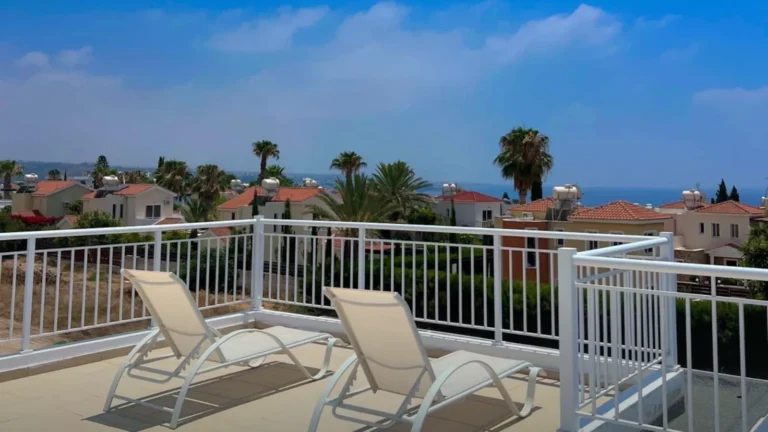
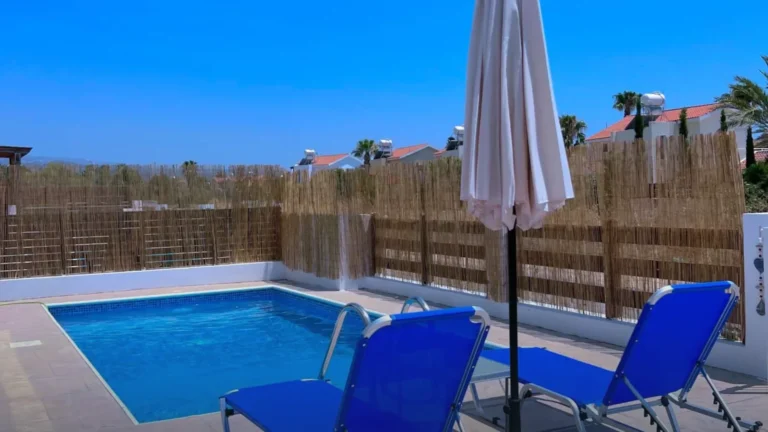
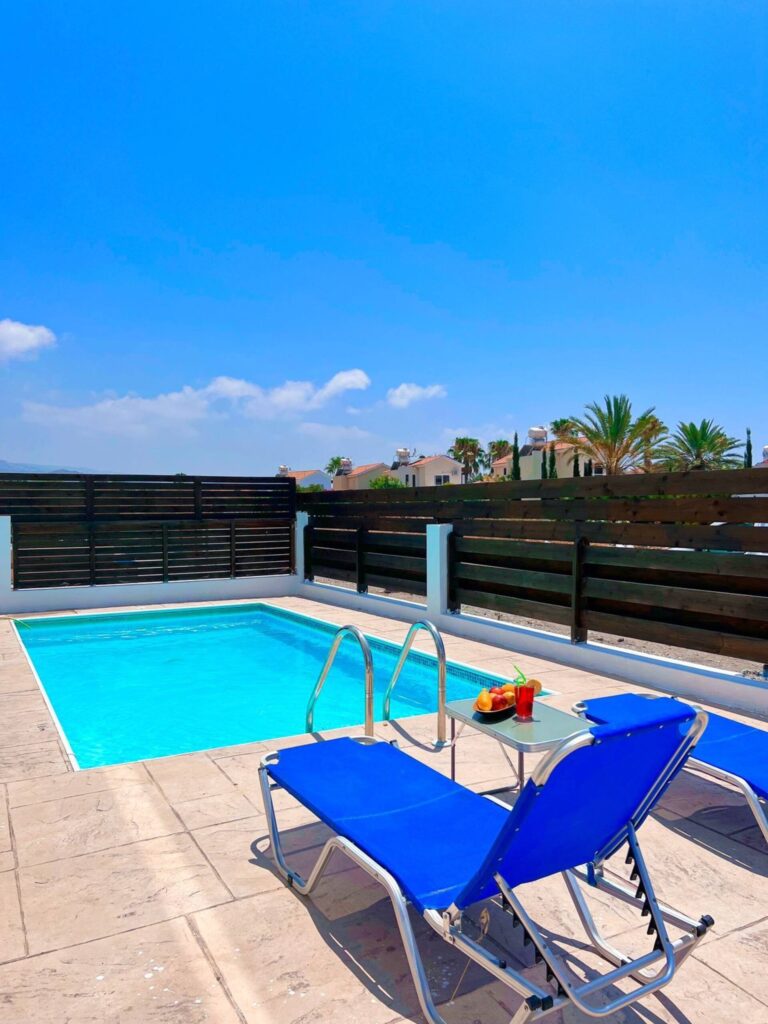
Two private pool villas with sea views – a great base for trips to Kourion, Paphos and the whole west coast. Ancient sites by day, the pool and sunset in the evening. Book direct with your host.
Check availability