Cyprus Cats: Why the Island Has So Many, the Cyprus Cat Breed and Where to See Them
Cyprus is often called the island of cats: estimates range from one million to more than two million cats, roughly as many as people or more. Cats have lived with people here for 9,500 years, and legend says Saint Helen brought boatloads of cats to fight a plague of snakes. You can meet them at Tala Cat Park near Paphos and at the monastery of St Nicholas of the Cats near Limassol. The best way to help is to support local charities that neuter and feed them.
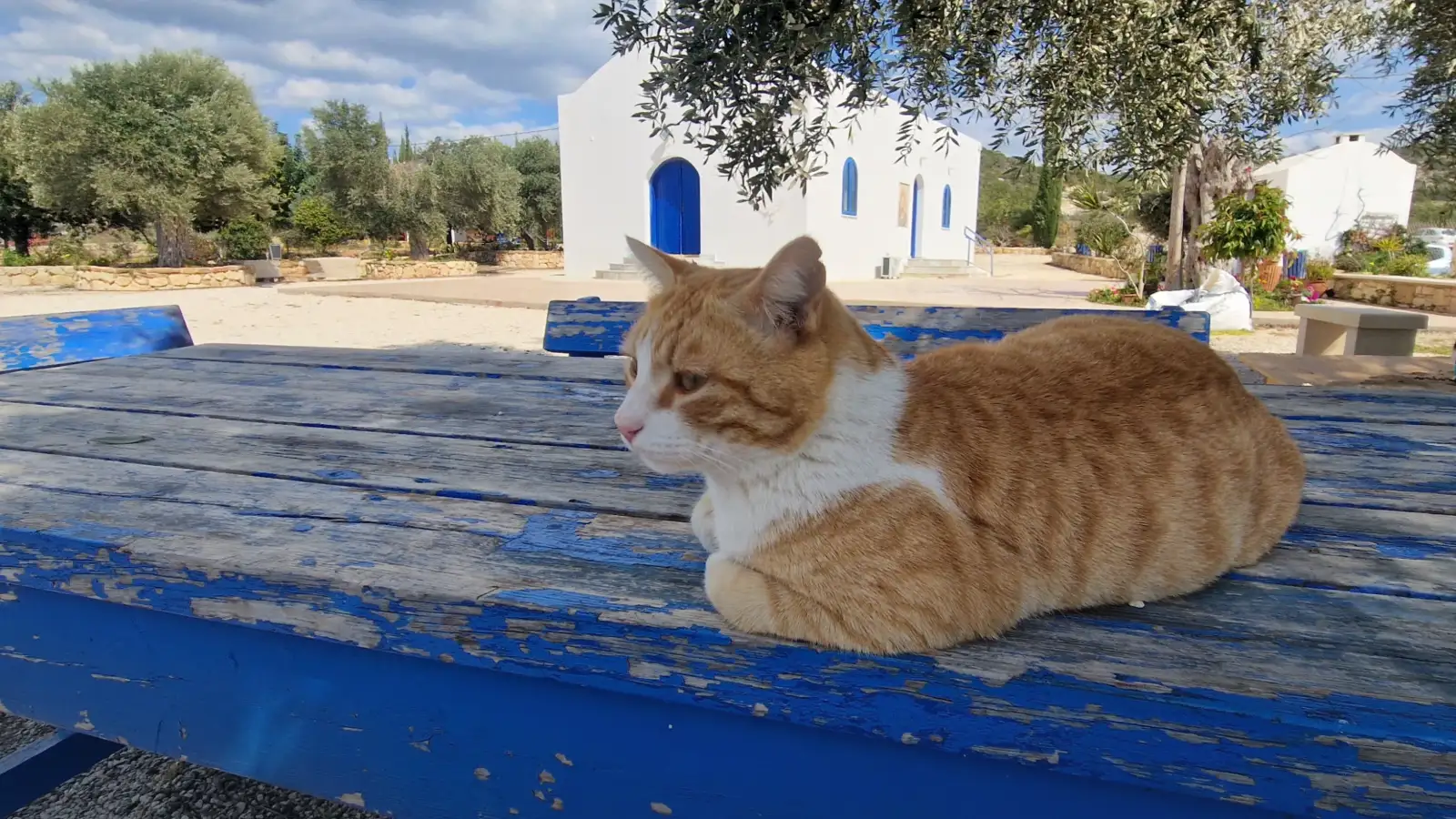
On a holiday in Cyprus you meet the cats before you meet the neighbours. They doze in the shade outside village churches, wait under taverna tables for a piece of fish and gather at the feeding stations that volunteers look after in Coral Bay and Peyia. For many visitors the cats in Cyprus are part of the holiday – and sooner or later almost everyone asks why there are so many. In this guide we explain the history of the island of cats, the Cyprus cat breed, the best places for cat lovers around Paphos and how you can actually help.
Why are there so many cats in Cyprus?
Nobody has counted them exactly. Officials estimate around one million feral cats, about one for every resident of the Republic of Cyprus. Animal welfare groups believe the real figure is much higher, and a scientific study published in August 2026 put the stray population at more than two million. That probably gives Cyprus the highest number of cats per person in the world.
The reasons are simple: a warm climate, food all year round from bins, tavernas and kind-hearted locals and tourists, and far too few cats being neutered. The national programme neuters only around 2,200 cats a year, while a single female can have several litters a year. The government announced it would triple sterilisation funding from €100,000 to €300,000 a year, but in 2026 the increase was delayed, partly because the veterinary services were busy with an outbreak of foot-and-mouth disease. An expanded island-wide scheme was due to start in autumn 2026. Most of the work is still done by volunteers who trap, neuter and return the cats to their colonies.
| Cats in Cyprus | Facts and figures |
|---|---|
| Feral cats | around 1 million (officials) to over 2 million (2026 study) |
| Population of the Republic of Cyprus | around 1 million |
| Cats neutered in the national scheme | around 2,200 a year |
| Sterilisation budget | increase from €100,000 to €300,000 announced |
| Oldest cat buried with a human | Shillourokambos, around 9,500 years old |
Cyprus cats history: 9,500 years alongside people
The Neolithic cat of Shillourokambos
Cats are not native to Cyprus, so the first settlers must have brought them over by boat. How close the bond already was became clear at the Neolithic site of Shillourokambos near Limassol. In 2001 French archaeologists led by Jean-Denis Vigne found a human grave with the complete skeleton of a cat about eight months old just 40 centimetres away. The two had been buried together around 9,500 years ago. The study, published in Science in 2004, is seen as the oldest evidence of a special relationship between humans and cats – thousands of years before the Egyptian depictions of cats.
Saint Helen and the boatloads of cats
The most famous story about the cats of Cyprus is a legend from the 4th century. After a long drought, the Akrotiri peninsula was infested with venomous snakes. Saint Helen of Constantinople, mother of the Emperor Constantine the Great, is said to have founded a monastery there on her way back from Jerusalem. Constantine then sent a governor called Kalokeros, who brought boatloads of cats from Egypt or Palestine to deal with the infestation of snakes. The snakes were defeated – and the headland is still called Cape Gata, Cape of the Cats. The monastery is said to have had two bells: one for prayer and one to call the cats for food. The Greek Nobel laureate George Seferis even wrote a poem about it in 1969.
The Cyprus cat: a breed with long legs
Most cats in Cyprus are ordinary domestic cats living on the streets. Over the centuries, however, a locally adapted variety of cat has developed, a landrace of domestic cat known as the Cyprus cat, Cypriot cat, Saint Helen cat or Saint Nicholas cat. Typical features are a large, muscular body and back legs that are slightly longer than the front legs. Many are tabby, with a soft coat that grows thicker in winter.
The World Cat Federation (WCF) has fully recognised the breed since 1 July 2012 under the name Aphrodite’s Giant, in shorthaired and semi-longhaired varieties. The International Cat Association (TICA) accepted it in 2017 as a preliminary new breed called Aphrodite. According to TICA, males weigh about 6.8 to 8.2 kg and take three to five years to reach full size.
Where to see cats in Cyprus near Paphos
Tala Cat Park
The best-known place for cat lovers in the west of the island is only about 20 minutes’ drive from Coral Bay. Tala Cat Park is a sanctuary for stray and abandoned cats in the grounds of the Agios Neophytos Monastery in the village of Tala. It was founded by Dawn and Mark Foote more than ten years ago and, according to the charity, now cares for around 500 cats. The park is open every day from 9am to 1pm, 365 days a year. There is no entry fee, but donations are very welcome: food, vet care and medication cost the charity around €12,000 a month.
Combine your visit with the cave monastery of Agios Neophytos next door, one of our hidden gems in Cyprus. Children love the cat park too – more ideas in our Cyprus family holiday guide.
St Nicholas of the Cats Monastery
The monastery of Agios Nikolaos ton Gaton, Saint Nicholas of the Cats, stands on Cape Gata, about 15 km west of Limassol and south-east of Akrotiri Salt Lake. It is considered one of the oldest monasteries on the island, and the present church dates from the 14th century. The monastery was abandoned in the 16th century; since the 1980s Orthodox nuns have lived here again – together with many cats said to be descendants of the snake hunters. It lies within the British Sovereign Base Area of Akrotiri and is open daily from 8am to 5pm. Wear clothes that cover shoulders and knees.

From Coral Bay it is about 80 km, a little over an hour by car. It works well as part of a day trip to Limassol, Kourion and the salt lake – see Paphos to Limassol.
| Place | What to expect | From Coral Bay | Open |
|---|---|---|---|
| Tala Cat Park | sanctuary with around 500 cats | 10 km, approx. 20 min | daily 9am–1pm |
| St Nicholas of the Cats | cat monastery on Cape Gata | 80 km, just over 1 hr | daily 8am–5pm |
| Coral Bay and Peyia | volunteer feeding stations, charity shop | on your doorstep | – |
A hire car is the easiest way to reach both places. Our tips on driving on the left, insurance and deposits are in Car Rental Cyprus.
Compare car hire for your day trips
Localrent only works with local car rental companies in Cyprus – handy for trips to Tala and Cape Gata. Check the deposit and excess before you book.
If you book through this link, we earn a small commission at no extra cost to you.
Can you stroke and feed cats in Cyprus?
Most Cypriot cats are used to people and many are happy to be stroked. They are still feral cats, though, not pets. Let the cat come to you, do not pick it up and make sure children wash their hands afterwards. Clean any scratch or bite well and see a doctor if it becomes inflamed.
If you want to feed them, buy dry or wet cat food from the supermarket instead of sharing bread or seasoned leftovers, and put out water in summer. Ideally use one of the feeding stations run by volunteers, where new arrivals are spotted, trapped and neutered. In a taverna, ask the owner before you feed a cat at your table – not every guest likes cats.

Why do Cyprus cats have clipped ears? A cat with the tip of one ear removed has been neutered – vets mark cats from trap-neuter-return schemes this way. If a cat looks seriously ill or injured, contact a local animal charity rather than taking it away yourself. Around Paphos, Paphiakos & CCP Animal Welfare says it runs a 24-hour emergency service.
Worth knowing: in 2023 an outbreak of feline infectious peritonitis (FIP), caused by a new strain of feline coronavirus, killed many thousands of cats in Cyprus. The disease cannot be passed to humans. Cyprus became the first European country to approve two treatment options, including the Covid drug molnupiravir.
How to help the cats in Cyprus
The biggest difference is made by neutering, not feeding. Every neutered female prevents dozens of kittens being born on the streets. According to the Associated Press, neutering a female feral cat costs around €55 in Cyprus, and many small charities pay for it entirely through donations.
- Donate: money or items such as cat food, litter, towels and bedding to a local charity like Tala Cat Park.
- Coral Bay and Peyia: the group Only TNR says it looks after 23 government-registered feeding stations and funds neutering partly through a charity shop in Coral Bay.
- Volunteer: Tala Cat Park needs volunteers above all – even a few hours on holiday help with feeding and cleaning.
- Share: sharing adoption profiles helps cats find a home.
Please do not trap street cats yourself. In 2026 rumours of cat theft spread across Cyprus, and volunteers collecting cats for neutering were harassed and even taken to police stations. Leave it to registered organisations with experience and the right authorisation.
Adopting a Cypriot cat and bringing it to the UK
Many visitors fall in love with a cat and want to take it home. That is possible, but it needs planning. The safest route is through a rescue charity that knows the cat, has it checked, vaccinated and neutered by a vet and helps with the journey. To enter Great Britain from Cyprus, your cat needs:
- A microchip – fitted before the rabies vaccination.
- A rabies vaccination – then wait at least 21 full days after the first vaccination before travelling.
- The right document – usually an EU pet passport issued in Cyprus or an animal health certificate.
- An approved route – travel with an authorised airline or carrier on an approved route.
Tapeworm treatment is only required for dogs. Rules change, so check GOV.UK (Bring your pet dog, cat or ferret to Great Britain) and talk to the charity and your airline well before you travel.
Cyprus cats FAQ
Why are there so many cats in Cyprus?
A warm climate, plenty of food from tavernas and bins and too few neutering programmes. Only around 2,200 cats a year are neutered in the national scheme, while estimates put the feral population at one to more than two million. Cats were first brought to Cyprus around 9,500 years ago.
Are Cyprus cats friendly and safe to stroke?
Most are used to people and happy to be stroked, but they are feral cats, not pets. Let them come to you, do not pick them up and wash your hands afterwards.
Is the Cyprus cat a breed?
The Cyprus cat is a landrace found across the island. The World Cat Federation has recognised it as a breed called Aphrodite’s Giant since 2012, and TICA accepted it in 2017 as a preliminary new breed called Aphrodite.
Can I bring a cat from Cyprus to the UK?
Yes. It needs a microchip, a rabies vaccination at least 21 days before travel and an EU pet passport or animal health certificate, and you must use an approved route. Adopting through a rescue charity makes the process much easier.
Conclusion: enjoy the island of cats with open eyes
Cats are as much a part of Cyprus as meze and sunshine – and have been for 9,500 years. Behind the holiday photos, though, is a feral cat population far too large for the volunteers who care for it. Visit Tala Cat Park or St Nicholas of the Cats, feed cat food rather than leftovers and support a charity that neuters. For more ideas, read our guide to Cyprus holidays and our village guide to Peyia.
Sources: number of feral cats according to the Associated Press (October 2025) and Greek City Times (study, August 2026); neutering figures and budget according to Cyprus Mail (June and September 2026); neutering cost according to AP; Shillourokambos burial according to Vigne et al., Science 2004 (National Geographic, AAAS); legend and monastery according to Visit Cyprus and cyprusisland.net; Cyprus cat breed according to the World Cat Federation and TICA (Wikipedia); Tala Cat Park according to talacats.com; Only TNR according to its own information; FIP according to FECAVA and The Guardian (2023); pet travel according to GOV.UK; driving times by route planner (OSRM). Information without guarantee, as of November 2026.
Your place to stay in Coral Bay
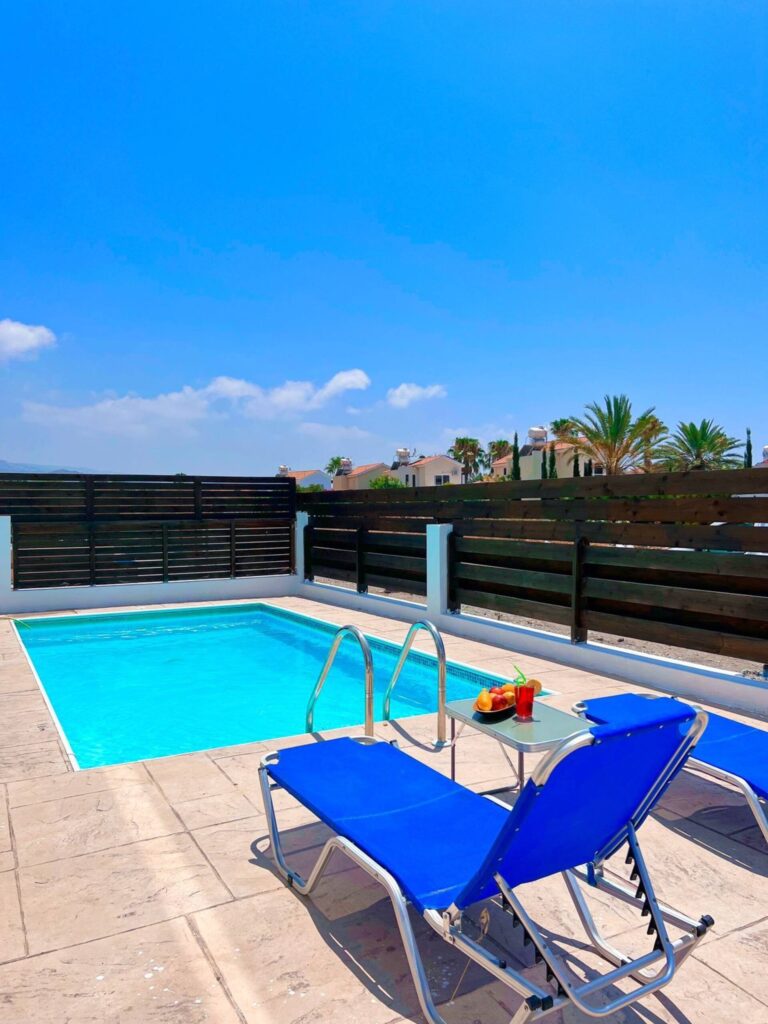
Two private pool villas with sea views, just 20 minutes from Tala Cat Park. Booked directly with your host.
Check availability