

Paphos Archaeological Park: mosaics, Odeon and ancient Nea Paphos
Roman villas with the finest floor mosaics in Cyprus, a UNESCO World Heritage Site in Kato Paphos – with opening times, entrance fee, a walking route and tips from Coral Bay
← All things to do around Coral Bay
- What: the archaeological site of the ancient capital Nea Paphos with Roman villas, mosaic floors, an Odeon and a Byzantine castle ruin, a UNESCO World Heritage Site since 1980.
- Where: in Kato Paphos, right next to Paphos harbour.
- From Coral Bay: about 13 km, roughly 20 minutes by car.
- Opening times: daily, 16 April to 15 September 8:30am–7:30pm, otherwise 8:30am–5pm.
- Entrance fee: €4.50 according to the Cyprus tourism authority. Allow at least two hours.
What is the Paphos Archaeological Park in Cyprus?
The Kato Paphos Archaeological Park – also signposted as Kato Pafos – covers most of the remains of ancient Nea Paphos (“New Paphos”), the most important archaeological attraction in the city of Paphos. From the 2nd century BC to the 4th century AD it was the capital of Cyprus – first under the Ptolemies, then in the Roman period.
Nea Paphos was founded at the end of the 4th century BC by King Nicocles, the last ruler of Palaepaphos near Kouklia, who moved the city to the harbour. Most of the remains you see today are from the Roman period, but the ancient monuments span the Hellenistic and Roman periods through to the Middle Ages, including Byzantine buildings.
The archaeological site has been a UNESCO World Heritage Site since 1980, together with the Tombs of the Kings necropolis and the Sanctuary of Aphrodite at Kouklia. Archaeological excavations continue to this day, including work by the University of Warsaw since 1965. The site is run by the Department of Antiquities of the Republic of Cyprus.
The mosaics of Nea Paphos: House of Dionysos, Theseus, Aion and Orpheus
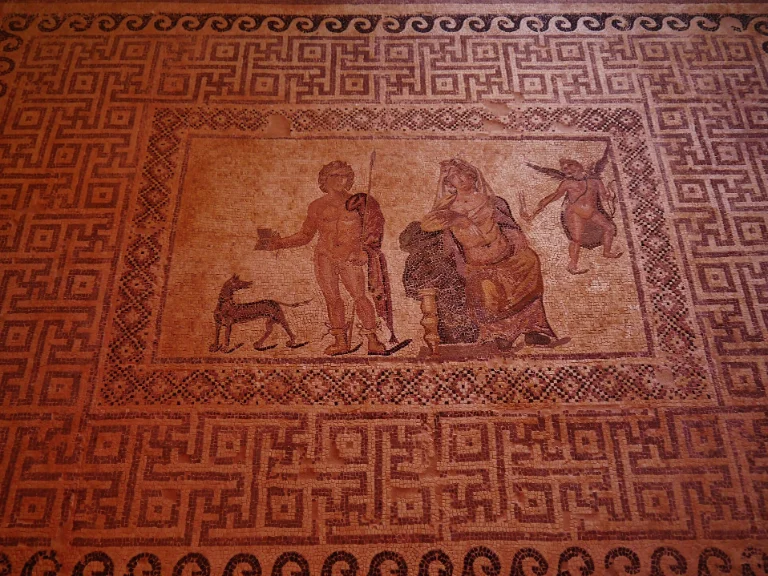
The park is famous for the mosaic floors of four Roman villas. These floor mosaics depict scenes from Greek mythology, the grape harvest and hunting, and are among the best-preserved mosaics in the eastern Mediterranean – a monument to the wealth of Roman Pafos.
House of Dionysos
A farmer found this villa by chance in 1962 while ploughing his field. It dates from the end of the 2nd century AD and covers about 2,000 m², of which 556 m² are paved with mosaics. The best known are the Triumph of Dionysos and the story of Icarius, whom the wine god taught to make wine, next to the inscription “the first wine drinkers”. The villa was abandoned after the earthquakes of the 4th century AD.
House of Theseus
The Villa of Theseus was the residence of the Roman proconsul (governor). It was built in the second half of the 2nd century AD and lived in until the 7th century. It takes its name from a mosaic of Theseus fighting the Minotaur. Only the southern half has been excavated – and that alone measures about 120 by 80 metres.
House of Aion
The mosaic in the House of Aion dates from the middle of the 4th century AD and shows mythological scenes in five panels, among them Leda and the Swan and the beauty contest between Cassiopeia and the Nereids. It was discovered in 1983.
House of Orpheus
West of the House of Theseus lies the House of Orpheus, with 3rd-century mosaics of Orpheus with his lyre, Hercules and the Nemean Lion, and an Amazon. These mosaics are currently not open to the public.
Exploring the archaeological site: Odeon, Agora and Saranta Kolones
- Odeon: a small theatre from the 2nd century AD with room for about 1,200 spectators, right next to the lighthouse.
- Agora: the Roman market square in front of the Odeon. Since 2011, archaeologists from the Jagiellonian University have been searching beneath it for the older Hellenistic agora.
- Asklepieion: the remains of a sanctuary of Asclepius, the god of healing.
- Saranta Kolones: the “Forty Columns” castle, built by the Byzantines at the end of the 7th century to protect the harbour from Arab raids, later remodelled by the Lusignans and destroyed by an earthquake in 1222. It is named after the many granite columns found on the site.
- Panagia Limeniotissa: the ruins of the Early Christian basilica of Panagia Limeniotissa near the harbour.
- Lighthouse: it stands in the middle of the site and is visible from almost everywhere – a useful landmark.
From the entrance by the harbour, start with the mosaic villas. The mosaics in the House of Dionysos are protected by a roof. Paths then lead across the open site to the Odeon and the lighthouse. Some paths are uneven. According to the tourism authority, the park is partially accessible to wheelchairs.
Paphos: Half-Day City Tour with Tombs of the Kings Entry
About 4 hours with guided visits to the House of Dionysus in the archaeological park and the Tombs of the Kings, a photo stop and free time in the old town. Hotel pick-up and entry tickets included. Rated 4.4 out of 5 from over 170 reviews on GetYourGuide (October 2026).
If you book through this link, we earn a small commission – the price stays the same for you.
Opening times and entrance fee
- 16 April to 15 September: daily 8:30am–7:30pm.
- 16 September to 15 April: daily 8:30am–5pm.
- Closed: on Christmas Day, New Year’s Day and Greek Orthodox Easter Sunday.
- Entrance fee: €4.50 per person, 20% off for groups of more than 10 people. The Tombs of the Kings cost extra (€2.50).
- Day pass: €8.50 for all Department of Antiquities sites on one day, plus 3 days for €17 and 7 days for €25.
All details according to the Cyprus tourism authority. Opening times and prices can change at short notice.
Getting to the Paphos Archaeological Park
By car: from Coral Bay, follow the coast road past the Tombs of the Kings to Kato Paphos. The drive is about 13 km and takes around 20 minutes without traffic. The entrance is at the harbour, where there is parking. From our villas Asteria and Halia it makes an easy half-day trip.
By bus: bus 615 links Kato Paphos harbour with the Tombs of the Kings. Check the timetable and stops with the bus operator before you go, as frequencies change with the season.
Tips for visiting the archaeological park
- Mosaics first: in the House of Dionysos you are under the protective roof. Out on the open site there is very little shade.
- Go early or late: in summer it gets very hot at midday. It is nicest just after opening or in the late afternoon.
- Water, hat, sturdy shoes: the paths are long and partly uneven.
- Use the day pass: combined with the Tombs of the Kings on the same day, the €8.50 pass pays off.
- Do not step on the mosaics: stay on the walkways and paths.
What to combine with the archaeological park
- Tombs of the Kings: the necropolis of Nea Paphos, about 2 km north. Read more in our guide to the Tombs of the Kings.
- Paphos harbour and Paphos Castle: promenade, cafés and fish tavernas right next to the entrance.
- Aphrodite’s Rock: the birthplace of the goddess, see our guide to Aphrodite’s Rock.
You will find all destinations with driving times in our guide to things to do around Coral Bay.
Paphos Archaeological Park: frequently asked questions
How much is the entrance fee for the Paphos Archaeological Park?
€4.50 per person according to the Cyprus tourism authority. A day pass for all Department of Antiquities sites, including the Tombs of the Kings, costs €8.50.
What are the opening times?
Daily, from 16 April to 15 September from 8:30am to 7:30pm and from 16 September to 15 April from 8:30am to 5pm. Closed on Christmas Day, New Year’s Day and Greek Orthodox Easter Sunday.
How much time do you need for the park?
Allow at least two hours. If you want to see all the mosaics and the Odeon at a relaxed pace, plan half a day.
Which mosaics are the most impressive?
The best known are in the House of Dionysos, including the Triumph of Dionysos and the story of Icarius. The Theseus mosaic in the Villa of Theseus and the Aion mosaic are also well worth seeing.
Is there shade in the park?
The mosaics in the House of Dionysos are under a protective roof. The rest of the site has very little shade, so bring water, a hat and sun protection.
How far is the archaeological park from Coral Bay?
About 13 km. By car you reach the entrance at Kato Paphos harbour in around 20 minutes.
Last updated: October 2026. Sources: opening times, entrance fee and accessibility from the Deputy Ministry of Tourism (visitcyprus.com), villas, mosaics and excavations from Wikipedia and UNESCO, Saranta Kolones from Wikipedia, driving time via route planner (OSRM, 9 October 2026), tour details from the provider on GetYourGuide. Cover photo: Stefan Bellini, CC0, via Wikimedia Commons.
Your base near Paphos
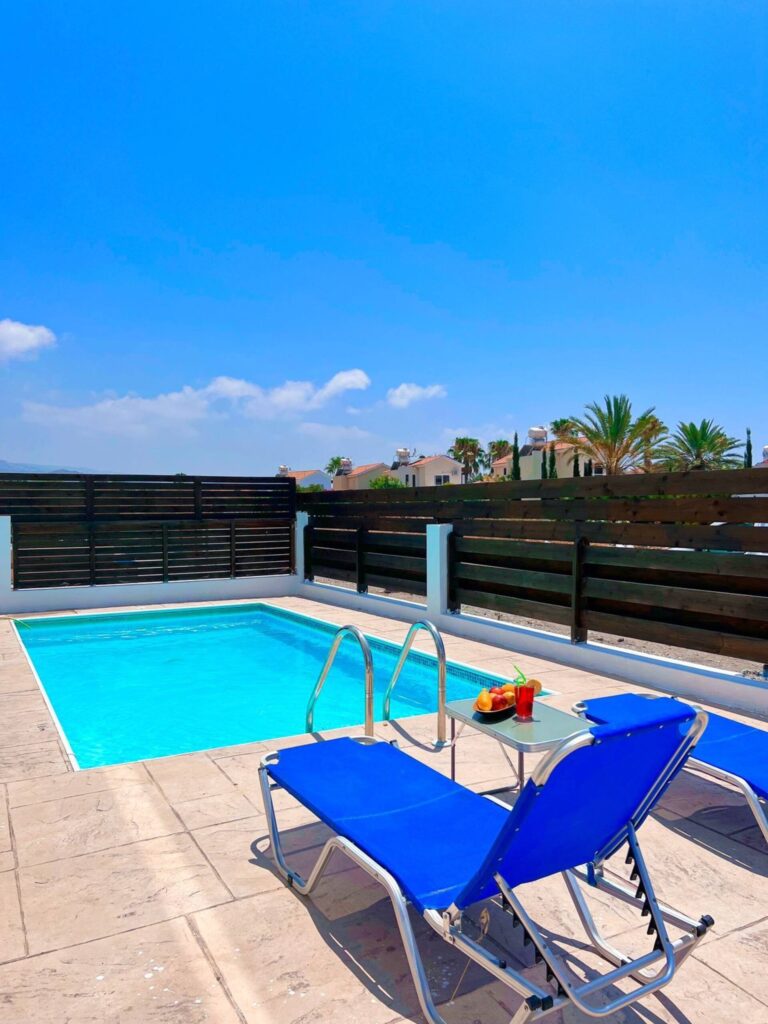
Our two villas in Coral Bay are about 20 minutes from the archaeological park and the harbour. Private pools, sea views and booked directly with your host.
Check availability